Thursday, July 7, 2022

Conan's Adventures in the Hyborian Americas


 In the last post, I explained how in the final current issue of  Marvel's  King Conan, Conan paddles off into the sunset, at last reaching the verdant coast of an unknown continent. This is either what is now called North or South America, or possibly an island off the coast.

Does this lead directly to L. Spraque L. DeCamp and Lin Carter's Conan of the Isles? Prince Conn is, and always has been a staple of Marvels chronicles of King Conan, is a Lin Carter creation (and has such has long been hated by Conan purists). De Camp intended his and Carter's A Probable Outline of Conan's career to be canonical. This was back during the barbarian boom of the sixties and seventies, Conan was going great guns at Marvel. The purist, with reason, vehemently disagreed, and now only the original Conan tales by Howard are considered canon, while the rest are basically pastiches. Therefor, all you can do is speculate. 

Conan of the Isles has the sixty some year old monarch, bored of tedious court life, venturing across the Western Sea, to battle a conclave of wizard who survived the sinking of Atlantis. Most of the action takes place on Antilan islands off the coast of the Central American mainland, in the city of Patchuan ruled by the demon god Xotli. I remember from the book and comics adaptation the giant dragon-lizards in the pit beneath the city, that are dispose of the corpses of those sacrificed to the demon-god, and how Conan sets the dragons loose to terrorize the city. After defeating the priests and their evil god, Conan ventures further west, knowing there lies the even greater kingdom of Mayopan (undoubtedly proto-Mayans), "tiger-like cats" (jaguars), and another apparent demon god the Quetzalcoatyl (an Aztec deity; the Mayan name for essentially the same god is Kukulcan). It is easy to see the ancient meso-American culture in the place and character names, as well as a connection of Atlantis with those cultures. 

None of this violates canon, as the tales of Conan as king by DeCamp and Carter, and the subsequent ones by Marvel, mostly by Roy Thomas, are based on a passage by Howard himself, that he journeyed to Khitai and other lands, including the two great continents across the Western ocean.

But's there's no mention of Patchuan or Xotli here. What the authors seem to have done is return to the source material, ignored the events of Conan of the Isles, and written their own version of what Conan might have encountered west of the Hyborian continent. 

The fly in the ointment here is Prince Conn. As with Conan of the Isles, the prince assumes the throne after his father's abdication, but little else remains the same. Conn is already a part of Marvel's continuum, and was invented by DeCamp and Carter. Plus he's already a part of Marvel's expanded universe. 


As is, of course. Conan of the Isles itself, which was adapted by Marvel in one issue of the annual "Red Shadows, Black Kraken", scrapped the next year in favor of a Jim Owsley story of two blonde twins with powers, one good the other evil, born during the era of King Kull--but that's another story. The entire adaptation of Carter's and DeCamp's pastiche was published in a graphic novel. 

So what gives here?

Of course, Marvel hasn't always been consistent with it's use of Conan anyway. One thing I've always been confused by is whether of not the Marvel incorporated Howardian continuity into their own "universe." This was debated back and forth in the letters column back in the day. It seemed settle when one writer opined that Howard's Conan tales take place in a world that "will eventually become our world today, not the Marvel super heroes' world". The editors seemed to agree and that was that. Only  there was a (very good) issue of What If, drawn by Ernie Chan that had Conan drawn into the modern world through the well of the sorcerer Shamash Shum Ukin, a villain from an early issue of Savage Sword. During his stay, there is a very brief cameo by Peter Parker and Mary Jane, proving that it's the Marvel super heroes' world after all! Another What If  had Wolverine travel back to the Hyborian Age to team with Conan. There was at least one other What If that had Conan in the modern world, but I know next to nothing about it, other than it was still the same universe as Marvel. These instances were often dismissed for the fact that they were "what ifs" only, and never canonically occurred. But the Official Handbook of the Marvel Universe published around that time, made repeated references to the Hyborian Age, even including an entry on the Stygian god Set. The inclusion of Howard's hero in the now current Savage Avengers proves that Conan is, nowadays at least, a mainstay in the Marvel universe, as these stories are no "what ifs", but I have little idea of what goes on at Marvel these days. Only that having Conan adventure in modern Las Vegas (Zamora was the Hyborian Age's own "City of Sin"), is a far cry from the Howardian continuum, or even DeCamp's, Carter's, and Roy Thomas's subsequent embellishments. 

But I've let myself get sidetracked again. 

Conan of the Isles wasn't Conan's only venture to the Americas during Marvel's run, either. Sometime during the 90s Savage Sword run, Conan, while king of Aquilonia, traveled up the coast of South and North America, encountering a civilization that was either pro-Inca or Aztecs (probably Incan, as the name of capital Kuzco, suggests), the American Indians, and finally the Inuit where he slays a huge white whale feared by the natives as a god.  On the page that featured a map of Western Hyborian age world-continent, they presented a map of the American continents as they existed during that time. As Africa and Eurasia were merged into one super landmass, so were the Americas, the Central American landmass being much wider and vaster. 


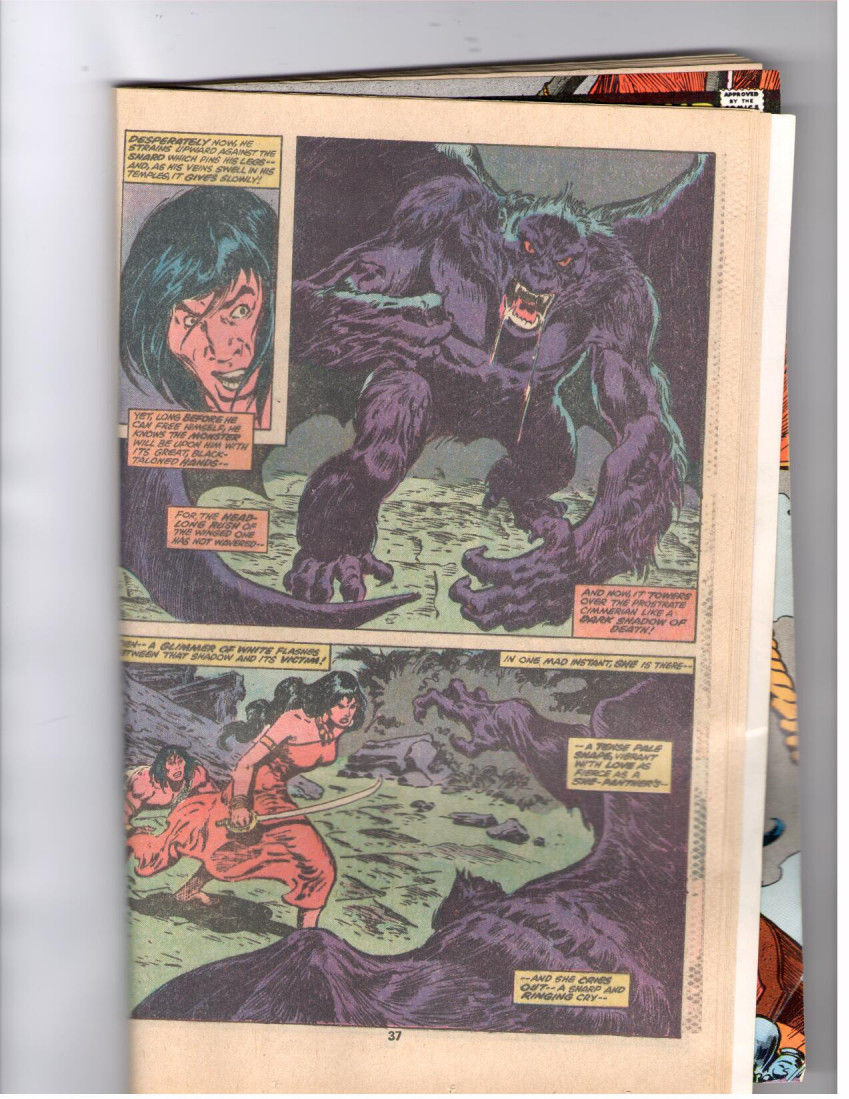
The story above has Conan defeating an evil shaman, who is able to summon a monstrous bear spirit


Panel showing Conan smoking a native American peace pipe...


And communing with a coyote "Trickster" spirit


Prince Conn is merely a infant at this time, and his father has already had substantial adventures in the "New World" although he has reached here from the opposite direction than Conan of the Isles, having sailed east from Khitai. So Conan's venture to these two lands is already established (at least within the Marvel universe) well before the DeCamp and Carter novel takes place. 

There are two tales within the Howard canon that have a definite connection with the ancient Americas. One fits definitively with Conan's chronology, the other is, well, more controversial, being an original Howard tale, just not one about Conan. Until Roy Thomas converted into a Conan yarn for Marvel. 

The first Howard story is "Red Nails" a Conan classic that has been adapted first by Roy Thomas and Barry Windsor-Smith back in Marvel Conan's early days, and then by another company in the 2000s for a three issue story arc in The Cimmerian.  This series only adapts original Conan tales. "Red Nails" is one of Howard's originals that I wish would have been re-adapted by one of New Masters, preferably Tomas Giorello, one of the young artists who has assumed the throne of the Old Masters, but it has never happened. 


The story had Conan and Valeria lost in the dense jungles of Darfar, when they have a run-in with a huge dragon, an apparent survival from prehistoric times. Conan slays the beast with a spear slimed with the juice of Derkata's Apples. Afterward, they come upon an abandoned city upon a flat plain. The city turns out to be a single vast palace with no open air streets or plazas, the walls, incredulously, of pure jade. This is not the first time Howard has Conan encounter a city like this. In Howard's "Xuthal of the Dusk," adapted by Roy Thomas as "The Slithering Shadow," Conan and the girl Natala discover a city of  Xuthal in the desert that proves to be one vast pleasure palace, whose drugged inhabitants are the prey of a Lovecraftian entity called Thog. 

Anyway, the city in "Red Nails" turns out to be not quite deserted after all. Conan saves a man from a seeming-supernatural entity, who takes them to a sealed-off sector of the palace-city It has become the feuding ground of two tribes of an unknown people who took refuge within its walls a century early. They are not city's original builders. Though once of a single tribe of refugees, a disagreement broke out among them and they split into two tribes when Techulli stole Xoctalanc's betrothed. They have been been slaughtering each other ever since, and vast network of darkened rooms between Techulti and Xochtalanc have become their battleground. The Techutli become the victors during Conan and Valeria's stay, and the Xoctalancas are wiped out; the victors bemoan the loss of a captive to flay alive. Their own dreams have been haunted ever since the feud's down of being captured and taken to Xoctalanc, the ultimate horror to meet the same grisly fate. For yes, whenever a warrior from the opposing tribe has been taken captive by the other, the poor devil is literally skinned, alive and screaming, for his captors' amusement. 

It should be noted here that the ancient Aztecs worshipped a "flayed god" and often wore the skins of flayed sacrificial victims. Some North American Indian did flay captive enemies alive. 

The name of the city is Xuchotl, not its original name, whose builders were presumably devoured by the stego-dragons (summoned by a wizard, out of some primordial age?) And the names of the inhabitants are meso-Amercian derivation as well. How then, did these American refugees end up in the heart of the main Hyborian world-continent? Howard does not tell us, and there has been speculative fiction on the part of other writers as to how they got there either.

What were they doing there?

There is one additional Conan tale of displaced Americans that might provide a connection, though not an answer. This is "Feeders from the Sky", aka "Nekht Semerkht" named for the title's villain and  based on the original Howard tale of weird fiction set in America, Hyborianized by Roy Thomas. In it Conan encounters a strange city, this one of definite meso-american built with a central tiered temple. It is tended by slaves "whose copper-skins are not that of Stygians." Conan saves a girl, Princess Ixlaca, from an evil stygian sorcerer Nekht Semerkeht who tries to sacrifice insect -winged saurians, the feeders of the title. How again, did Ixlaca's people com to be in Stygia? And how did the come under the thrall of the wizard? Some like the author, whose detailed account the story can be found  here:

https://classiccomics.org/thread/19/annotated-savage-sword-conan?page=95

are of the opinion that they might be of the same people as the inhabitants Xuchotl. As with "Red Nails" no explanation is provided by the author. 


Brontotheriums of the Miocene, apparently one of few prehistoric creatures to have survived into the Hyborian age as rare animals. They are called "thunder-beasts" by the Hyborians, what their Latinate name really means, based in turn upon what the Native Americans called them. The Indians supposed the beasts crashed to earth during thunderstorms, and smashed themselves into the ground, where they found their bones!


Howard's original "Nekht Semerkeht" took place in North America, during Coronado's search for the legendary golden cities of Cibola (a false trail invented by the Indians to get rid of him). A lone Spaniard stumbles upon a strange city of Nekt Semerkeht, an ancient Egyptian sorcerer who, in Howard's version, is the one displaced. Once again, the hero must save a native princess from the winged monstrosities. But the conclusion was left unfinished by Howard, and science fiction author David Drake gave the story an ending that was not quite in keeping with Howardian heroism.


There is a passage from Howard's original, where the Spanish hero battles a native. Before the Indian is slain he sees in the gleaming armored Spaniard, "the doom of his entire race." Howard, a man of his times, wrote the story from the perspective of his protagonist, a white man; but that didn't mean he couldn't relate to the other man's perspective.


And what did Conan find out (perhaps the answer to the previous question?) once he rowed himself to the "New World," at the end of his long career in the known world of the Hyborian age. Neither Conan of the Isles, nor Marvels conclusion to Conan's tale provides. There has never been a tale of what Conan's true final adventures were--but someday, so long as Howard's hero stays the test of time, there may well be. 


King Conan (the Comic) is Dead


 Marvel's current run on Conan has finally breathed its last. There's been a lot of excuses for the recent sparseness of Conan comics, from Covid-19 to a lack of paper, but what I've always suspects to be the root cause is plain old flagging sales. Marvel's newest King Conan was always intended to be a mini-series, and even that has come to an end, and that's pretty much it for Marvel's Conan (for now, at least), unless you count Conan's regular appearance in Savage Avengers, and I don't count that. 

   Marvel attempts to wrap up the entire Conan story with this tale, while still leaving the door open for possible future adventures, and they do a decent enough job. While exploring the Western Ocean, Conan is ship-wrecked on a cursed island far out at sea, inhabited by the zombies of previous shipwrecked adveenturers. Marooned with him is Conan's reccuring foe and mortal adversary, the Stygian wizard Thoth-Amon, and there ensues a dramatic show-down. The mistress of the island is a displaced Meso-American Princess, who was once fell in love with an Aquilonian adventurer, who betrayed her and sacked her city, and now thirsts for revenge against all Easterners. She is bound by the curse to the island, until another unfortunate takes her place. She also commands great red apes and snow-tigers, both Hyperborian natives who she uses to attack Conan, and then tries to use Toth-Amon to blackmail him, until she learns the two are foes. While all this ensues, we're treated to flash backs in Aquilonia, of King Conan trying to get his son Prince Conn to go off adventuring on his own, like he did as a youth. There ensues a non-lethal sword battle between father and son, and at last Conan relents, and decides that he is the one who needs to go on adventuring again. Conn assumes the Aquilonian throne. Toth-Amon driven by his own lust for power, takes the Princess's place, setting her spirit free, and Conan paddles out further west, in the final panel reaching the coast of what is now South or North America. 

  And that's where the story leaves us. What will happen next? Conan never truly dies, because he's always revived every few years. That he only persists in Savage Avengers though, speaks volumes of how currently the trend favors super-heroes. it's a wonder Conan was brought back at this time at all. 

And I think I've split this post, because it will take too long to explore Conan's adventures in the Americas.


Tuesday, July 5, 2022

Conan's Prehistoric Adventure Featuring Homotherium


 In Savage Sword of Conan #151, the story, called "Fury of the Near-Men," writer Chuck Dixon takes Howard's barbarian hero into the lush savanna's south of the Black Kingdoms of Kush in what would now be sub-Saharan Africa. Though at this time, Africa is merged with what will later become Europe, and the Mediteranian Sea does not exist. James, Silke, author of Frazetta's Deathdealer series, may have borrowed that last idea from Howard's already-established Hyborian age. 

Anyway, Conan encounters a number of prehistoric survivors in Hyborian-age Africa. First he battles a pack of (extant in our time) painted wolves, also known as African Cape hunting dogs. 

Then he encounters a wagon-train, bearing a family of travelers from the north, including the obligatory pretty girl, from the European region of the Hyborian world-continent, with a few native guides (I forget if this was an acting troupe, or the Hyborian equivalent of a safari; I'll guess the latter). Anyway, a huge saber-tooth feline attacks them, killing a guide, before the girl manages to wound it with her bow. Its Conan, of course that attacks and manages to slay the beast, following a horrendous battle. That's all good and well---but note that this is NOT the conventional saber-tooth tiger that is almost always the species featured during any encounter with a saber-tooth. This creature is of the species homotherium, which did live in Africa during the late Plesticene, but also throughout Europe to (north) east Asia, and even into the northern part of North America, at the same time that the more infamous smilodon ruled the Americas south of there. The homotherium ("man-beast") is sometimes referred to as a "dirk-toothed" cat rather than saber-toothed. It was believed to have died out earlier around 300,000 years ago, but are now believed to have roamed Europe much more recently, though these survivors were evidently much rarer than the European cave lion. This is evidenced by a small statuette by a Cor-magnon artist dating from a mere 30, 000 years ago! 
Carving thought to represent homotherium latitdens, showing a short-tail, a possibly lightly spotted coat, and no visable fangs, as would be the case with a dirk-tooth. Source:
http://darrennaish.blogspot.com/2006/03/late-survival-of-homotherium-confirmed.html


Anyway, after slaying the beast, and sticking its head on a pike, Conan bonds with the travelers, sometime afterward, the party is attacked a band of strange ape-men, something like
surviving australopithicines which retained their simian appearance,  but seem to be of much higher intelligence than their ancestors. A separate evolutionary branch, in other words, than the one that led to ourselves.

The girl and her family get captured. Conan is injured, but is saved and nursed by a rival tribe of beast-men, who seem more feline than primate. Conan makes allies with them, and on their way to save the traveler, two huge mastodons are seen. The city of evolved ape-men is quite bizarre, a constructed labyrinth of wood tunnels, covered and interconnected. 

They raid the ape-men's fortress and save the family, Conan killing the huge bloated king of the pithicus tribe, and all ends well, with the suggestion that cat-like beast men will always remember Conan in their folklore. 

"Fury of the Near-Men" was drawn by the combo of Gary Kwapisz and Ernie Chan, two of the Old Master of barbarian comics, who'd been teaming up for Savage Sword since the mid-eighties. 

Chuck Dixon, who was in the middle of a long run on Savage Sword at the time, most might remember for creating the Batman villain Bane for DC comics, though his work on Marvel's Conan was extensive. 


Comments

Sunday, October 3, 2021

Howardian Heroes

 The following are a list of Howard's heroes taken from my Comics blog post, Barbarian Heroes.


Conan


No need to introduce this guy, the original barbarian hero created by the same man who created the genre. 

I've decided to use the iconic image created by Frank Frazetta here. The covers of the original pulps contain REH's Conan stories generally made Conan appear more like Roman legionare with short-cropped hair, or even depicted him as looking rather sissified. It was Frazetta who at last established Conan as the Howard described him, with a mane of black hair, and smoldering blue eyes, and the depiction has endured ever since. 

It was Roy Thomas who first adapted Conan for the comics, after first optioning Carter's Thongor. Conan's Marvel run lasted well over 100 issues, both in their color comic, and the companion black and white mag, Savage Sword of Conan. There was also the King Conan comic (later slightly altered to Conan the King), which detailed Conan's adventures as monarch of Aquilonia, which lasted a fairly respectable run, but not nearly as long as other two. King Conan adapted some of DeCamp and Carter's tales, and included Conan's wife Zenobia, and Prince Conn, who was a Carter creation, and hated by some fans. Roy Thoma adapted many of Howard's tales for both Conan the Barbarian and Savage Sword. More unusually, he adapted quite a few of Howard's non-Conan tales into Conan stories. One story arc even adapted Norval Page's novel Sons of the Bear God, the difference being it was now set in the Hyborian kingdom of Shem rather than central Asia, and staring Howard's hero instead of Prestor John (a legendary Christian king). 

A number of artists worked on the Conan comics, including Barry Windsor-Smith on the early issues, John Buscema (perhaps the most famous of the Conan artists) Ernie Chan, Gary Kwapiz, Rudy Nebres Pablo Marcus, Alfredo Alcala, to name some of the Greats. 

While Thomas penned nearly all of the issues during the seventies, soon other writers took the reins, notably Michael Fleisher, whose wildly imaginative stories introduced Conan to re-occuring antagonists such as Wraal, the Devouver of Souls and Bor 'Ac Sharaq, a Baracan pirate who was obssessed with vengeange on Conan to the point of madness. Other writers included Bruce Jones, around the same time that he was a regular writer for Ka-Zar, and generally wrote twist endings for his Conan tales, the same as for his horror stories. Thomas returned to Savage Sword during the nineties, and penned mostly original tales that took Conan even to Australia, and adapted deCamp's novel Conan and the Spider-God. He also transformed another non-Conan (horror) tale of Howard's, "The Black Hound of Death" into a Conan yarn. 

Sometimes in the ninties, though, readers seemed to lose interest in Conan. Marvel tried to alter it, and officially cancelled Savage Sword, only to resurect it as as Conan the Savage. These efforts didn't work, and soon Conan's Marvel run ended. But it wasn't long until Dark Horse picked up Conan, and tried to keep him near to Howard's original vision. And for the most part they were successful; perhaps tastes had swung back, but whatever the reason, Conan enjoyed a successful comeback at Dark Horse. A younger generation of artists now drew him, including Cary Nord, who'd been inspired by the Old Masters at Savage Sword. Another new artist, Tomas Giorello, may even have surpassed some of those Masters, and did the art on the several issue adaptation of Hour of the Dragon , Howard's one full length Conan novel, also known as Conan the Conqueror

Currently, Conan has been passed back to Marvel, where it is doing fairly well, with good, though not great, stories and art. Marvel is also doing some strange things with Conan these days, like sending him to the modern (Marvel) era, and teaming him with the Avengers. Conan's future seems uncertain at this point. 

Kull


Kull is another barbarian hero created by Howard, perhaps the next most famous one to Conan, also adapted by Marvel, and later by Dark Horse. Neither ran for a very long time. He was a predasessor, and perhaps a prototype to Howard's Cimmerian hero. Kull lived earlier, in the Time of Atlantis, which was a actually a land of Barbarians; the higher civilizations existed on the Thurian continent, where Kull deposed a tyrant named Borna and took the crown of Valusia for himself. Kull was an orphan raised by tigers, and who took the tiger as his totem animal, as Conan did the lion (Amra). Though humans dominated Kull's era, there also existed a few survivors of the serpent-men, who possessed the insidious ability to shape-shift into humans, and a winged race of bird-headed men, as introduced in an Alan Zelenetz story, "The Amulet of Ka." Kull might well have been an actual ancestor of Conan, as the blacked-maned Atlantean barbarians were established as ancestral to Cimmerians, as told (I think) in Howard's history of the Hyborian age. Though separated by millenia, Conan and Kull did manage meet on occasion, by means of sorcerous time-portals. 

Kull's comic book run is a bit confusing. He first appeared in Marvels' Bizarre Adventures, illustrated by John Bolton, and there was very brief black and white Kull magazine, Kull and the Barbarians. I didn't really pay much attention to the small color Kull issues Marvel produced during the seventies.

 In the eighties, they brought Kull back, starting with direct-to -comic -book-store issues at the same time that they marketing Ka-Zar, Mirconauts and Moon Knight in direct sales market. I still do  not know why they did this, but it was sort of cool; there were two or three "first issues" of Kull, one being a werewolf tale with a wrap-around cover, and printed on slick paper. It featured the art of little-known Great John Bolton. The other two direct premiere issues also featured wrap-arounds. One featured Bolton art with Kull on the front and his tiger totem on the back, with interior art by another Great, Nestor Redondo. The third premiere issue of Kull sported a Joe Jusko wrap around by Joe Jusko (not a painting) of Kull battling tigers. 

This issue was interesting in particular, because it was written by Bruce Jones, who introduced Kull's sister Iraina, also an orphan reared by Thurian tigers, who humiliates Brule the Spearslayer, Kull's Pictish friend, then beheads her own ruler, and goes on to conquer most of the known world with her army of female were-tigers. Of course she is ultimately undone by her brother. After that Alan Zelentz took over the scripting, penning the aforementioned "Amulet of Ka" story, in which Kull sets out to recover the aforementioned amulet to save the life of Tu, his councelor. 

After that, the Kull series went mainstream, with no more wrap around covers and zero- ad format Though the scripts maintained the general quality, it didn't last long, because, well, Kull didn't have the staying power that Conan did. Kull went on to appear in a back series in Savage Sword for a time in the late eighties, written by then-Conan writer Chuck Dixon, whose take on Kull often had gruesome twist endings. More recently Kull appeared at Dark Horse, though little as been seen of him since. 

Solomon Kane


Solomon Kane was a Puritan hero created by REH. He appeared in a number of short-lived comics and limited series. Kane was intelligent brooding and introspective, and a bit philosophical, even more so than Kull. Kane traveled the world, combating evil. Inevitably, the Kane stories tended toward horror. While this was almost true of Howard's original Conan tales, it was even more true here. 

I'm out of time, and I'll write more later on the rest of the heroes.

Okay, time to post more. 

Cormac Mac Art


Cormac Mac Art was a lesser known creation of Howard, that had an even lesser known comics run. His stories were set in historical times, and he might have been a Viking hero. There was little fantastic or supernatural elements in most of them, but one story fragment contained in the Cormac volume of the Howard Library series of paperbacks during the late ninties, contains references to King Arthur, as well as a horde of half-human monsters and satyr like beings. Some of the other stories in that volume are pastiches by science fiction writer David Drake, in addition to  original Howard tales. 


Bran Mac Morn


Bran Mac Morn was Howard's Pictish hero. Howard had an interest and admiration for the Picts, a race/culture from Breton's ancient past. Bran lived at the time of the ancient Roman Empire, and to defend his people against the Romans, he enlists the aide of a race of subterrean beings who had once been men, a staple of REH's fiction, in the horrific "Worms of the Earth."


In the Howardian universe, Picts were also around during Kull's time (in the Pictish Isles) and during the Hyborian age, where they were confined to a stretch of wildland known as the Pictish wilderness. Howard describes them as "a white race, though swarthy," though never spoken as such by the Aquilonian settlers of the region. The Picts are adversarial in the Conan tales like "Beyond the Black River," where Conan fights on the side of Aquilonia, the indigenous Picts basically filling the same role as American Indians to white settlers. Savage Sword writers often penned their own tales set in the Pictish Wilderness, notably Chuck Dixon, who often depicted them as far less noble than Howard did. Though Picts, "like American Indians" according to the letters column once, varied in nature from tribe to tribe, and were occasionally de-picted sometimes as heroes, as in "The White Vulture," Dixon often portrayed Picts as a degenerate culture. Generally, the more savage and ruthless the Pictish tribe was, the more degenerate, with one especially savage tribe literally wallowing in filth. 

During the transition between the Hyborian Age and out modern era, Howard establishes that the Picts were defeated by the Celts. 

Later on author Karl Edward Wagner, creator of his own Barbarian, Kane, wrote a few Bran Mac Morn pastiches. Bran has seldom been de-Picted in comics, but Dark Horse did do an adaptation of "Kings of the Night." "Worms of the Earth" was adapted long ago in an issue of Savage Sword as a backup feature, then reprinted as a single graphic novel years afterward. 

Red Sonja


Red Sonja was a character quasi-created by Howard. His original creation was of a swordwoman named Red Sonya (slightly different spelling), set in historical times in "Shadow of the Vulture." Roy Thomas re-planted her as a Hyrkanian in the Hyborian age, and tweaked her a bit. 

Sonja had a relatively short-lived series in the seventies, followed by a limited series during eighties. She also showed accasionally in the Conan comics, as a backup feature, or to cross swords or team up with the Cimmerian. Since thn, however, she's become much more popular, notably in the Dynamite series. 

During the eighties, there were a series of Red Sonja paperbacks porduced, sporting covers by Boris.

One Savage Sword issue told the very disturbing backstory of Sonja. She grows up happily with her parents and siblings, when one day an army officer from her retired father's  millitary days shows up with his men. Her father seems to realize that the man is dangerous, for he herds his wife and family inside their cabin. He greets him in a friendly manner however, calling the man "old friend," though the man replies that he is now "first in command," indicating a possible rivelry, more than a friendship. After a brief exchange, the man simply utters the words "Kill him." His men kill Sonja's father, and go on to slaughter Sonja's innocent family while the captain bursts into laughter. When the (now teenage) Sonja threatens him with a sword, he spares his men from killing only to rape her himself. Then, on a sadistic whim, he leaves her alive. Years later, after Sonja can best near anyone alive with a sword, she comes upon a band a brigands torturing some poor wretch. After driving them off, she discovers their victim is none other than the captain who murdered her family and raped her! The unknown man has finally recieved his due, though Sonja feels robbed of her personal revenge. 

Niord


Niord was Nordic barbarian native to some primordial, possibly pre-Hyborian era. Howard's tale of Niord and the Worm was both stand-alone, and one of his James Allison stories. Allison is a modern disabled man who experiences dreams of earlier incarnations, this one being the tale that supposedly spawned all the legends of monster-slayer heroes down though that ages, including Siegfried, Beowulf, St. George and others. Niord is a warrior of a blond-haired barbarian tribe, who journeys into the jungled southlands. There they come in contact with the Picts, here de-picted as a dark-skinned, brutish people. During a battle, Niord spares the life of the Pictish warrior Gorm, and the two become friends. Later, when Niord's tribe makes the fatal error of camping among the ruins of a cursed ruin, in spite of the warnings of the Picts, Niord finds them slain. He and Gorm seek out Satha, a gigantic serpent with venhom-bearing fangs (another Howardian staple), whom he slays and coats his arrows with the poison (the story also features Nirod's battle with a saber-tooth tiger.


He then used the envenhomed arrows to slay the slayer of his people. This turns out to be a somewhat catapillar-like, Lovercraftian monstrosity, that slithers forth from a well in the ancient city, summoned by the piping a bizarre, vaguely ape-like entity. It is "not a beast, as humanity knows beasts" according to Howard. "Valley of the Worm" was printed in Supernatural Thrillers with art by Gil Kane. It has been reprinted since in Savage Sword, though always as a stand-alone. Thomas, surprisingly never transformed the tale of Niord into a Conan story.

  In another James Allison tale, "Garden of Fear"another northern warrior presses southward into verdant lands, only to have his love Gudrrn, a woman whom the most ravishing beauties of today are mere shadows, captured by a bizarre flying man. He saves her or course, by drivng a herd of mammoths to trample the garden of blood-drinking plants that circle the winged man's tower. Howard establishes that winged man is some relic of some earlier time, a theme repeated in "Queen of the Black Coast."

"Garden of Fear" WAS turned into a Conan tale by Thomas, and illustrated by Barry Windsor-Smith.


Esau Cairn


This is a strange one. Esau Cairn was the hero of Amalric, Robert E. Howard's one sword and planet novel, his one attempt to imitate Burrough's Mars stories. "Amalric" was also the name of a blond-haired warrior who was a friend of Conan's in "The Scarlet Citadel". Amalric, however, is the title of the both the novel, and short comic series from Dark Horse (I thinkThat makes a bit hard to remember that Amalric is the name of the,  planet, where the story takes place, and Esau Cairn is the name of the hero. The hero is disabled, rather like James Allison, and a professor friend of his propels him, via a new invention of his, to the suface of Amalric, where he is reincarnated in a new body. Thus Cairn's advetures begin. Amalric is frought by mostrous animals, including tusked bears, giant felines, and hyena-like beasts, what seems to be a huge serpent, and some sort of carnivorous moose-like monstrosity. Sentient races also inhabit Amalric, including dog-headed manlike things, a race of beast-men, who capture Cairn and take him to their city. During a war between the beast-men and a black-skinned winged race known as yagas, Cairn and his newfound love escape. But the woman is later made prisoner of the Yagas, and Cairn must rescue her. During the climax, a giant tentacled monster appears, and it's been speculated that this final scene of the protagonists' escape, may actually have been penned by Otic Adelbert Kline, a vetern of the sword and planet genre. The publication above depicts Cairn's battle with the yagas. 

Amalric was adapted by Marvel comics in their Heavy Metal-like magazine Epic, and later a sequal to Howard's original was published by Dark Horse. 


Friday, October 30, 2015

Conan


As I've indicated, Robert E. Howard's original Conan tales border on being horror stories. Some may fully qualify as such. Howard, as already mentioned seemed to have a horror of apes, and ape-like beings and entities, as these often haunt the pages of his fiction. The "Ghost-Ape" story, "Shadow of the Beast," has already been mentioned, though a number of such creatures turn up in his Conan tales. Among the most famous is "Queen of the Black Coast,"in which Conan and his mate, Belit, queen of  band of pirates, travel up the coast of Hyborian-age Africa (that continent is still mashed with Europe in Howard's fictional age). They encounter a brooding, eerie lost city, filled with treasure. The pirates fear the stash has some foul curse upon it, because of the strange winged shape seen haunting the ruins. They fear it is a "winged ape", and that it bodes ill for them all. But Belit is too greedy and plunders it anyway. But the slavering monstrosity who presides over the ruins seeks them out. At one point Conan is temporarily drugged into  unconsciousness by the perfume of the Black Lotus. Under its spell, he experiences visions of an advanced civilization of winged man-like beings who flourished at the dawn, and how they were somehow unable to leave their city once the jungle overtook it. The race devolved into squalling madness over the centuries, culminating in a single abhorrent shape which still lurks among the crumbling stones.


 Conan wakes to find Belit slain by the monster and hung by a jeweled necklace from the mast of the ship. Naturally, the barbarian is consumed by a rage for vengeance, which, this being a Howard Conan tale, he naturally accomplishes. In the his final showdown with the winged horror, the monstrosity nearly claims Conan's life, when Belit's ghost returns briefly from Arallu to fight by his side, distracting the brute, and allowing Conan to triumph. Some might recall a similar scene from the original Conan movie, with the warrior maid Valeria also returning the save Conan's life. The scene was lifted directly for "Queen of the Black Coast," just as the scene where a crucified Conan crushing a vulture to death with his teeth is taken directly from Howard's "A Witch Shall be Born."


     "Queen of the Black Coast," was adapted to wonderful effect back in the seventies by writer Roy Thomas and artist John Buscema, as the pictures can testify. Recently, Dark Horse had a go at it, but to a lesser effect, compared to the 70s adaptation.

     There is also the monstrous gray ape whom Conan battles in the dungeon in Hour of the Dragon, also called Conan the Conqueror, and the gray ape that nearly kills Conan in "Shadows in the Moonlight." Are these possibly the same species, a variety of ancient Hyborian flesh-eating ape-creature? Possibly they are, as these apes are particular to man-meat, as is the carnivorous ape in the non-Conan tale "Shadows in Zembabwe." The ape in this latter tale is described as having silver-gray fur, and a survival of the prehistoric ages, so perhaps it is a last survivor of Hyborian gray ape? In "Shadows in the Moonlight," Conan tells the rescued girl Olivia, after his near-fatal battle with the monstrous primate that "his kind dwell in the forests of the hills [on the mainland]...they are haunters of darkness and silent places."


    Perhaps more famously for Conan is the tale "Rogues In the House." This features an ape-like monster named Thak, who is the "pet" of a priest, Nebonidus, aka the "Red Priest." Nebonidus has raised Thack as a cub, but has an adult the man-ape has turned on him, and the wizard is now a prisoner within his own palace. Thack roams within the twisting, labyrinthine, halls of the mansion.. He is, as Nebonidus explains to Conan and his companions, not a true ape, and sort of evolutionary transition between ape and man. Modern science might classify him as Australopithicus Robustus, or perhaps Homo Habilus; in any event some of man's early ancestral forms seem to have survived up into the Hyborian age. Eerily, Thack seems of near-human intelligence, and mimics his former master, in that he now wears the scarlet hooded cloak of Nebonidus; it's the same red cloak artist Frank Frazetta depicts him wearing in the famous painting of the story's climactic battle. A very similar red-cloaked man-ape showed up in the hall of mirrors in the movie Conan the Destroyer. That beast might have been a creation of Thoth Amon's sorcery, but writers Roy Thomas and Gerry Conway, though they wrote an entirely new story, were not above inserting some famous Howardian scenes.


 In addition to the apes and ape-monsters which shamble monstrously throughout Howard's tales, a number of giant serpent-monsters slither through their pages as well. Howard seems to have shared with a large portion of humanity a horror of snakes. The two short horror stories "The Dream Snake," and "The Cobra in the Dream," depict serpents as the instruments of a  character's demise, even when the victim is sound asleep. In the former tale, the narrator is found crushed by what seems to have been a gigantic phantom serpent, supposed until then to be a product of his imagination. Snakes of horrifying proportions also abound in the Conan tales. One type of monstrous serpent that turns up frequently is one Howard refers to in "Beyond the Black River" as "The Ghost Snake." This is a monstrous serpent of fifty feet plus, combining the worst aspects of the constrictor and the viper. The trunk of a ghost snake most resembles that of a monstrous python; but it also sprouts the venom-bearing fangs of its smaller, poisonous relatives. In "Black River," Conan aids some Aquilonian frontiersmen into the Pictish wilderness.

Deep within the vast oak forest, an Aquilonian man named Balthus is captured by the Picts and forced to witness their strange midnight ceremonies. A Pictish shaman conducts rituals that summon beasts from the depths of the forest. The Pictish wilderness, by the way, is a vast forested realm whose depths no man of the Hyborian "civilized" world has ever plumbed. The creatures summoned from their black depths are monstrous survivals from earlier times. The first monster summoned is a saber-tooth cat, or smilodon, which, eerily, Howard describes as having a pale, ghostly coloration. The smilodon kills and bears off a hapless forester tied to a stake, at the shaman's will.  Next, a gigantic white-colored "Ghost Snake" appears, summoned, apparently to swallow Baltus. But Conan manages to pierce the snake with an arrow, and it crushes several Pictish warriors in its death-throws.


A monstrous snake called Satha, which may well be a specimen of the Ghost Snake, makes an appearance to threaten Conan in "The Scarlet Citadel." The serpent is described by Howard as being a titanic eighty feet in length, with  a head the size of a horse's, and pale scales the color of hoarfrost. Another monstrous serpent, also called Satha, appears in the Howardian epic "Valley of the Worm." This Satha, which the hero Niord manages to slay to obtain his venom, is suggested to be a survival of prehistoric times, and might well be synonomous with the prehistoric titanoboa, if not for his poisonous fangs. "The valley of the Worm," features  Niord, (a prehistoric incarnation of invalid James Allison)a warrior of a nomadic warrior tribe, as they venture south into reeking southern jangles. Niord seeks revenge on the titular monstrosity, a Lovecraftian  monster that presides over a lost city, for the death of his tribe (Niord's people made the fatal mistake of staying the night in the city). The monster Niord must slay is summoned forth,by a hair-covered, vaguely ape-like being playing an eerie piping on a strange instrument.

   "Black Colossus" pits Conan against the sorcerer Thugra Khotan, who also has a bizarre, gibbering ape-like servitor, possibly a demonic entity, which is seldom glimpsed, save shambling into the wizard's tent at night, and driving the wizard's sorcerous chariot, which is pulled by a beast which appears to be a jet-black camel, but is really something otherworldly, as shown when the camel-beast sprouts wings in the distance, and soars into the sky.
   There are many of Howard's Conan (and non-Conan horror) tales featuring horrific monsters and entities, though one more I want to make note of here, for the hour grows late. It is the entity that  is the titular character in "The Black Stranger," which may be linked to the "dark man of the woods," also referenced in Irving's "The Devil and Tom Walker," and (I think) at least one of Hawthorne's tales. The figure of the Dark Man is a form of the devil in Irving, and though Irving describes being his protagonist as "neither Negro nor Indian," he seems linked inexorably with American racism. In the story, Conan and a band of pirates are searching for the treasure of Tranicos on the shores of the Pictish wilderness. Among them is a nobleman, Count Valenzo Korzetta, a man with a troubled past. When an innocent slave-girl blurts out that she has seen a "black man," on a boat riding on blue flame, Korzetta goes berserk, nearly whipping the girl to death, screaming that she is lying. Later, Korzetta grows morose, mumbling that he is doomed. He eventually confesses to the identity of the "black man" : no  man at all, but a demon who he had summoned from beyond, and whom he later betrayed. Later, they hear a demonic drum pounding away in the deep of the forest, and storm soon ravages their encampment. The demon soon enters Korzetta's apartment, and has his revenge. When I first read this, it was in a greatly altered form, altered, in fact, by Conan anthologist L. Sprague DeCamp, who made it turn out that the "black man" was the sorcerer Thoth Amon, a character of his own, and fellow scribe Lin Carter's creation (you might know him form the comics and movies in particular). The original, which I was pleased to locate is MUCH darker, and very much more true to what Howard had in mind.  Another, perhaps earlier version the story, "Swords of the Red Brotherhood," certainly as terrifying, was written as a straight, historical pirate yarn, this time with a self-exiled French nobleman pursued by a demonic entity.  It was, perhaps later made into a Conan tale. UPDATE: The story "Swords of the Red Brotherhood," is, like all tales of Black Vulmea, set in historical times. This times, the "black man" IS human, an African sorcerer, who is betrayed, and sold into slavery by a greedy French nobleman. The tale plays out much like the Conan version, with the Frenchman meeting his end, and Vulmea securing the treasure, turning the feuding pirates against each other, and  rescuing the Frenchman's daughter and her young friends, the two innocents caught  up in this madness.
Back when I first discovered the real writings of the true Robert E. Howard, I was forced to search through paperback stores for years (and later, the New Howard reader and Donald Grant delux editions) to secure all of his weird fiction, Conan and otherwise. It's only now, years later that virtually all of his stuff, even the obscure fragments was made easily available  in  paper and hardback editions.


Horror

    Robert E. Howard wrote a number of horror stories, and it being Halloween time, I thought I'd post a blog on some of them. Robert E. Howard is an author I'd been familiar with only "second hand" back in my teen years, as the creator of Conan. I regularly bought the magazine Savage Sword of Conan back in the eighties and nineties, but I'd never actually read anything by him, until I picked up a book titled Cthulhu, Mythos and Kindred Horrors.

    Now, I know what you're thinking--Cthullu is a Lovecraft creation. True enough, but this was a collection Howard's stories in the Cthulhu Mythos vein. Both authors wrote for Wierd Tales after all, and corresponded with and influenced one another. But while Lovecraft's protagonists were brooding, intellectual misanthropes (a bit like himself), Howard's heroes, even in these tales were cast in the heroic mold.

    Howard turned out to be perhaps THE most terrifying author I'd ever read the, and perhaps since. Stephen King himself is quoted as praising Howard's "pigeons form Hell" as a horror masterpiece, and opining that the prose of REH "practically gives off sparks." King, BTW, was not the most terrifying author I'd ever read, in fact, I'd say that pure unadulterated terror is NOT what he does best. I didn't even like King back then, because the core of he wrote seemed to be human tragedy. In depressing and disturbing prose SK is certainly the master. But no one tops Howard for evoking the emotion of fear. That might seem a bit strange to those familiar with Howard as the prime writer of heroic sword and sorcery. But the actual truth is, once I'd had a chance to read the original Conan stories penned by the creator, they actually read more like horror stories. Certainly, they ought to at least qualify as dark fantasy. The Conan stories of the comics, good as some of them were, are just a different brand than vintage Howard.

    Here are some of Howard's most terriying fiction.


"Shadow of the Beast"

    This is perhaps the Howard's second most terrifying short work of fiction, "Pigeons form Hell" being the first. In it, the hero pursues a renegade through the rooms of an ancient, decaying antebelum mansion at night--only to find him dead of terror. Then, a the ghostly presence begins to stalk our hero, a terrible unseen thing that throws a half-human shadow on the walls, and leaves bestial footprints in the dust.

    Spoiler Ahead: Only at the end do we discover the unseen presence is the spirit of maltreated circus ape who took refuge in the house. He was killed and his spirit bound to the place. Interestingly, apes and ape-like beings frequeuntly haunt the pages of Howard's fiction. He seemed to find them intimately terrifying. As an intersting sidenote, Marvel Comics once did an adaptation of "Shadow of the Beast," but which did not feature the ghost of the dead ape, but a sorcorer who had infused his spirit into the body of a great hound,  which was then able to speak and walk upon its back legs. They changed Howard's tale, but the story has the same dark, eerie quality of a vintage Howard. Roy Thomas once wrote, in an editorial of Conan Saga,  a mag of Savage Sword reprints, that is was "difficult to re-create"Howard's concept of a hound standing upon it's hind legs." This was almost certainly an error, though it made me wonder if Howard DID write another version with the same title, about  wizard in the form of a hound. However, it was later suggested to me that I might have been thinking of another Howard story (which I was not confusing with SOTB) titled:


    "The Black Hound of Death"

      This tale, also set in the black pine woods of the deep south, involved a refugee who is fleeing from a former friend, a man named Grimm. The two men had originally been fellow adventurers in East Asia, when they had happened upon a lost Mongolian civilization. Grimm was captured but his friend betrayed him and escaped back to America. Grimm was tortured for years by the preists of the wierd cult, and later the man who escaped recieved a letter from Grimm and his picture. Grimm has literally been transformed into a monster by his time in the lost city, his faced surgically sculpted into the likeness of a canine's elonated fanged muzzle. The cowardly former friend flees deep into the pine barrens (another Southern Gothic setting. But Grimm dogs him, and captures the man's innocent young daughter, whom he captures and prepares to flay her alive before her father's horrifed gaze. This part of the story, is well, "grim", to say the least, and Grimm's overwhelmingly horrific (and unjust) intentions  make me nauseous typing this. However, the hero arrives in the nick of time and the girl is saved. Realizing he can only take one victim with him to the beyond, Grimm tears out his traitorous former friends' throat with his fangs. Yes, it's horrific in the extreme.

     "Usurp the Night"

     This is the story of a young man and his pretty fiance living in a peaceful suburban region, when strangely, the town's pets begin to disappear. This isn't given much concern at first, but next children begin to vanish, and finally adults. During this time, our hero makes the aquiantance of an eccentric old man who lives alone  a huge Gothic house. He fears for the  gentleman's safety, as the disappearances grow increasingly worse. During his visits, he begins to hear the sound of pattering in the attic upstairs. As time passes, the sounds of whatever lurks in the attic grow in volume, until at last they sound elephantine. The final twist of this tale may have been fresh back in the thirties, the hayday of Wierd Tales; these days, however, the reader can see it coming, almost from the start. The suspense is hair-trigger, though, and climax is harrowing, with the hero battling a slobbering, tenacled monstrosity form the Elder world with a sword n the blackness of the attic.

      "The Devils of Dark Lake"

     This one of REH's wierd fiction tales that I first managed to read in "The New Howard Reader," published in the nineties, and featuring unpublished and super-rare examples of his fiction. While much of this was lackluster to the horror fan, some real gems were to be found, this story being one of them. Another Southern tale of black magic, the reason for this tales's obscurity is likely because it's a rare example of Howard craming TOO MUCH phantasmagoria into a single story.It involves Juju sorcery, man-eating gators, deadly shroudweaving spiders, and shambling half-human beastmen as antagonists for the hero.


     "The Fearsome Touch of Death"

    Also called merely, "the Touch of Death," his story is (or was) also very obscure and was featured in the second issue of "The New Howard Reader." It, too, is a contender for REH's most terrifying fiction, after "Pigeons form Hell." It invloves a man who is called to spend the night wating over the corpse of a man who died. This fellow has terrible phobias about the dead coming to life, and in the dead of night, after the candle blows out, his fears take on fantastic proportions within his psyche. The strange thing  about is tthis story is that while the prose at one point is absolutely nail-bitingly riveting,

SEVERE SPOILERS AHEAD:

There is revealed to be no actual monster or supernatural monster in the story at all. It is literally a zombie tale in which the zombie is all in the protagonist's brain; yet Howard manages to make it one of the most terrifying tales of all time. This is quite an accomplishment.


     "Black Talons"

     This tale is set in the depths of the Congo, with white settlers fearing a native attack, and featuring a juju man who has been executed, and his macabre revenge. This was also published in "The New Howard Reader." There is an appropriately grusome finish to this; however, it seemed to me a re-hash of another Howard story, one of Solomon Cane, which ultiized a severed hand as an instrument of vengence. In "Black Talons," it's a severed head!


     "Pigeons From Hell"

    This is probably Howard's most riveting terror tale, of two men having to spend the night in a great old, decaying antebellum mansion. The horror begins when one of the men disappears upstairs, and returns as an animated corpse, blood and brains oozing through a cleft scalp, and gripping a blood-clotted ax, the weapon used to kill him. This begins the protagonist's descend into nightmare. But no, zombies are not the true horror of this tale; something MUCH worse, a thing able to make the dead walk, lurks the black maze of upper rooms. Howard delves into African voodoo for the origins of his monster in this tale. But while the term "zombie" is of voodoo origin, the concept of the creature called a "zuvembie," is uniquely Howard's own. However, the details he gives the reader on the powers and origins of the zuvembie are so vivid that it actually could have been drawn form folklore as well. As writer James Van Hise observed in his book, The Fantastic World's of Robert E. Howard, lamaeting that other authors of the time tended to reveal surpernatural goings on as fake, "Howard doesn't cheat,", when it comes to delivering an actual supernatural menace at the end. The final twist is one the reader might see coming, but it is effective nonetheless.


        "Under the Baobab Tree"

       This is interesting contrast to the tale above, becuase it is the one story I'm aware of in which Howard DOES "cheat," when it comes to delivering a true supernatural menace. It is a tale set in Africa, in which the protagnist a young warrior on his test of manhood. A "Ghost-fiend" of the dark appears to be stalking the tribe, evidenced by monstrous clawed footprints beneath a baobab tree. However, it turns out that the "monster," is actually the fraudulant creation of the villain, the local witchdoctor. This tale is also very obscure.


     There are many, many others, including all of the Solomon Cane stories, "Horror form the Mound," "Wolfshead," about a wolf that becomes a man, rather than the reverse, "Moon of Zembabwe," featuring a gigantic carnivorous ape with saber-like fangs and talons of a tiger, and number of tales about races of men driven underground where they evolved into a race of horrors.


    A near-complete list, and more thorough discussion of Robert E. Howard's horror can be found here:


http://medleyana.com/2015/10/26/the-short-horrors-of-robert-e-howard/


  There are some examples of Howard's weird fiction that became lost. Such is the case of stories such as "The Vulture's Roost," Valley of the Golden Web," "Wendigo! Wendigo!", and "the Crimson Line."
  If the story "Wendigo! Wendigo!" was about what it's title suggests, it might have been among Howard's best tales of terror. Other writers, most famously Algernon Blackwood, have written of the Wendigo, the monster of northern Canadian folklore; it would have been interesting to see what REH's take on it might have been.